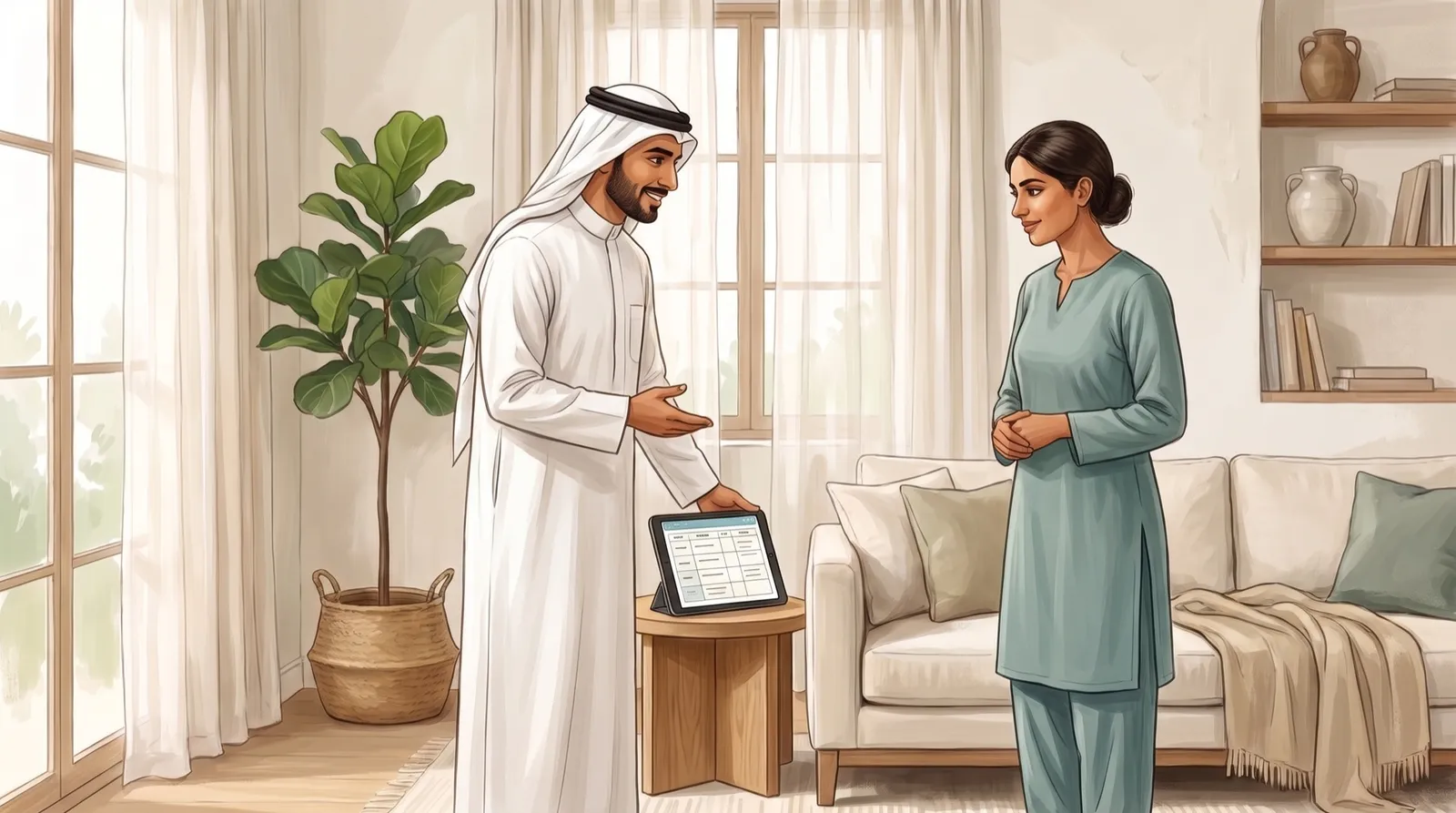

You chose a domestic worker, signed the contract and arranged the arrival. Now comes the month that decides how well the arrangement works. The first 30 days in Qatar put the Qatar ID and residence in place, settle how the wage is paid, confirm the health insurance the law requires, and set the tone of the working relationship.
This is a practical, checklist-led guide to that first month: the Medical Commission and the Qatar ID, paying your worker correctly (and why domestic workers sit outside the Wage Protection System), the mandatory health insurance, the working conditions fixed by Law No. 15 of 2017 on Domestic Workers, and how to settle the routine. Every rule here is drawn from Qatari law and official guidance.
Your first 30 days at a glance
Onboarding is a sequence, not a single event. Here is the shape of the month before we take it step by step.
| When | What to take care of |
|---|---|
| Before arrival / Day 1 | Confirm the standard contract, prepare a private room, and agree the weekly rest day. If you recruited through the Qatar Visa Centre, the medical and biometrics were done before travel. |
| Week 1–2 | Medical Commission fitness exam, fingerprints, and start the Qatar ID (residence permit) through the Ministry of Interior. |
| Week 2–3 | Confirm the health insurance is active, agree exactly how and when the wage is paid, and set the payment routine. |
| Weeks 3–4 | Settle into the agreed hours and weekly rest, review how the first weeks have gone, and confirm the first month’s wage was paid with a record kept. |
Step 1 — The Qatar ID and legal paperwork
In Qatar the sponsor (you, the employer) is responsible for the worker’s residence permit and pays for the process. If you recruited from a Qatar Visa Centre country, the fingerprints, medical exam and contract signing were completed in the worker’s home country before travel. After arrival, the remaining steps are:
- A Medical Commission fitness examination (Ministry of Public Health), which includes blood tests and a chest X-ray for tuberculosis.
- Fingerprints and biometric registration.
- The employer applies for and completes the Qatar ID (QID) and residence permit through the Ministry of Interior, via the MOI portal or Metrash2.
The process typically takes a few weeks after arrival. Government fees change over time, so confirm the current amounts on the Ministry of Interior or Hukoomi portal rather than relying on a quoted figure. Keep digital copies of the QID, the medical report and the signed contract together. If you have not completed the hire itself yet, our guide to hiring a maid or nanny in Qatar covers the stage before this one.
Step 2 — Paying your worker: wages and the minimum wage
Under Law No. 15 of 2017 on Domestic Workers, the wage must be paid at the end of each month, in the amount, by the method, and on the date set in the contract. Unlike company employees, domestic workers in Qatar are not brought under the mandatory Wage Protection System, so there is no WPS bank-transfer requirement. Even so, paying into an account in the worker’s own name and keeping a record of each payment is the safest practice and protects both sides in a dispute.
Qatar also sets a minimum wage that applies to domestic workers. Under Law No. 17 of 2020, the basic minimum wage is QAR 1,000 per month; where the employer does not provide accommodation and food directly, an additional QAR 500 for accommodation and QAR 300 for food are due. See our salaries by nationality guide for the going rates by role.
Step 3 — Health insurance and the health card
Health cover for your worker is the employer’s responsibility. Under Qatar’s mandatory health insurance system (Law No. 22 of 2021), the sponsor must provide approved health insurance for the domestic worker as part of the residency process, covering basic health services and emergencies. Historically, residents also held a low-cost health card for access to public primary care. Confirm the current requirement through the Ministry of Public Health or Hukoomi.
Arrange the insurance as part of the residence process, confirm it is active before the Qatar ID file is completed, and check what it covers. Because the scheme’s coverage and pricing have changed over time, confirm the current premium with your provider rather than assuming a figure.
Step 4 — The contract and the conditions the law sets
The relationship runs on the standard domestic-worker contract required under Law 15/2017, which is registered with the authorities. Beyond pay, the law sets a floor of conditions that apply whatever the contract says. Knowing them from day one prevents most first-month friction.
| Entitlement | What the law sets |
|---|---|
| Maximum working hours | No more than 10 working hours per day, broken by periods for rest, meals and prayer. |
| Weekly rest | At least 24 consecutive hours of paid rest each week, on a day set by agreement. |
| Annual leave | At least three weeks of paid annual leave per year. |
| Minimum wage | QAR 1,000 basic per month, plus QAR 500 accommodation and QAR 300 food if not provided in kind (Law 17/2020). |
| End of service | At least three weeks’ wages for each year of service, paid on completion of the contract. |
| Wage payment | Paid at the end of each month per the contract; domestic workers are outside the mandatory WPS. |
For the full explanation of the law, including both parties’ rights and obligations, see our guide to the Qatar Domestic Worker Law (Law 15/2017).
Step 5 — Probation and settling the working routine
A probation period, where the parties agree to one in the contract, is commonly up to three months. During it, either side can assess whether the arrangement fits. Use it as a genuine review window rather than a formality.
- Agree in writing what the role and the standard actually are.
- Check in honestly in the first two weeks, and again at one month.
- Raise issues early and specifically rather than letting them build up.
- If it is not working, understand the lawful options first. Our guide to cancelling, transferring or renewing a sponsorship covers them.
Step 6 — House rules and settling in
The paperwork is only half of onboarding. A worker who has just arrived, often in a new country, settles faster when the first days are clear and kind. This is not a soft extra: a settled worker is a safer and more reliable one.
- Give a proper welcome and a private space. Show the home, where things are, and how the kitchen and appliances work.
- Agree house rules together in simple terms: working hours, the weekly rest day, phone use, food, and how you will communicate. Write them down, in the worker’s language where possible.
- Set up communication early. Agree how the worker reaches family back home, and how you will raise anything that needs adjusting.
- Be patient through the first two weeks. Language, routines and expectations take time to align. Small corrections, kindly given, work far better than a long list on day one.
If safety ever feels uncertain, raise it early and directly: in any emergency involve the police, and for labour-rights concerns the Ministry of Labour’s complaint channels are the official route for both sides.
Your end-of-first-month checklist
By the end of the first 30 days, you should be able to tick every one of these:
- Qatar ID issued and saved, alongside the medical report and the signed contract.
- Health insurance active and the card kept with the worker.
- A fixed pay date agreed, the first month’s wage paid per the contract (at least the minimum wage), and a record kept.
- Agreed hours, a fixed weekly rest day, and house rules the worker understands.
- A first honest review of how the arrangement is going.
New to hiring and want the steps laid out interactively? Our hiring journey checklist walks you through every stage from decision to first month. And when you plan ahead for the end of service, the gratuity calculator estimates it, which under Law 15/2017 is at least three weeks’ wages for each year of service.